
Hibare's Alkacluster Logo
Hibare's Alkacluster ALC BUSINESS • pH 8.5–9.5
Water Science Laboratory
science The Science of Water • पानी का विज्ञान

What's in Your Water?
Evidence, Measurements & Care

Every detail from Hibare's Alkacluster pack-in guides and A4 reference sheets — explaining body water, the logarithmic pH scale, oxidation-reduction potential (ORP), molecular ion hydration, Calcium & Magnesium data, 10 L stainless-steel jar assembly, and historical scientific context.

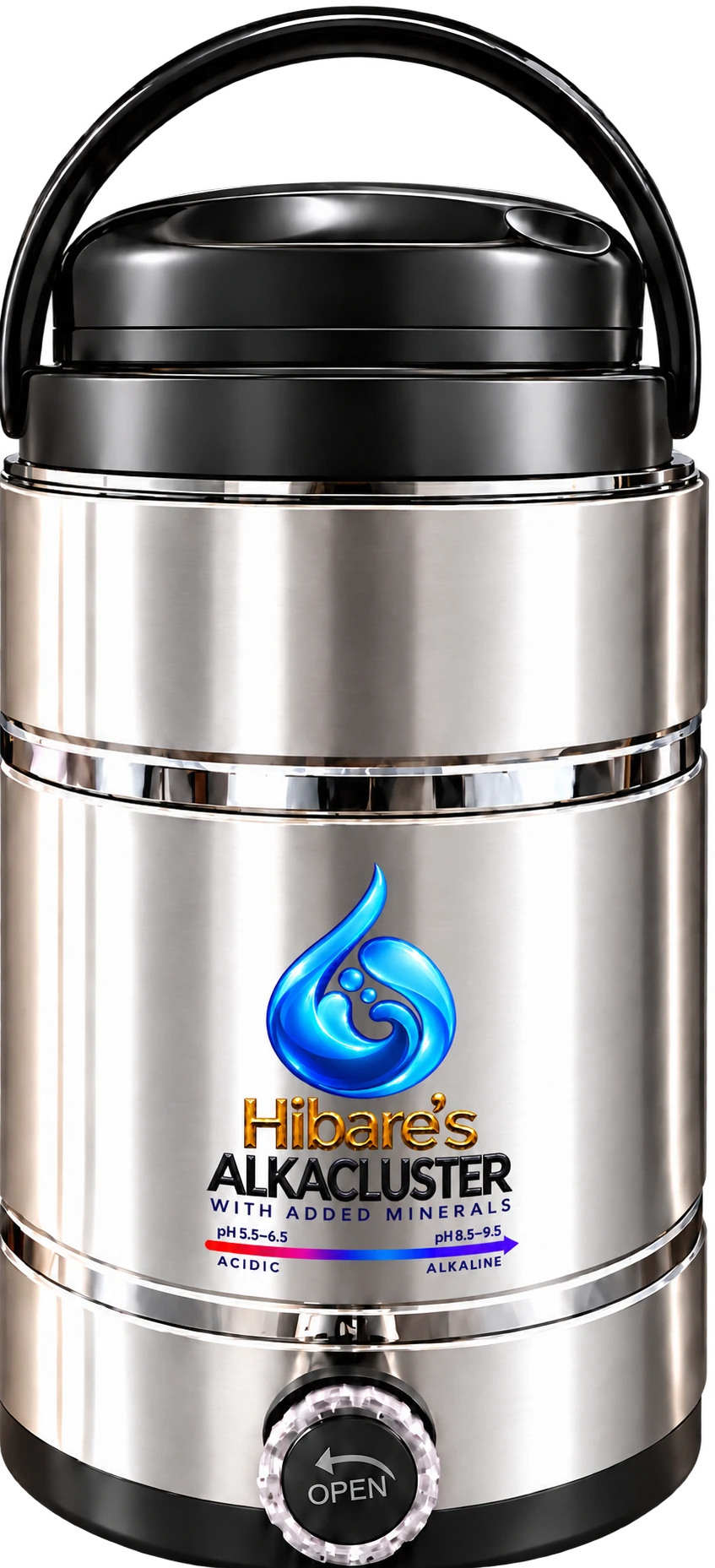
Hibare's Alkacluster 10 L Stainless-Steel Jar
10 L Stainless-Steel Jar • pH 8.5–9.5
01 / Body Water + pH

Water, Measured (शरीर में पानी + pH और क्षारकता)

Adult body water is often about 55–60% of body weight; age and body composition matter. Water supports temperature control, nutrient transport, joints, and waste removal. [1,2]

83%
Lungs (फेफड़े)
79%
Muscles & Kidneys (मांसपेशियाँ व गुर्दे)
73%
Brain & Heart (मस्तिष्क व हृदय)
Body-Water Illustration
70 kg × 60% = 42 kg of body water

This is body composition, not a quantity to drink. Approximate tissue composition, not hydration targets. [1]

The Original Alkacluster pH Scale (1–14)

pH = −log10 a(H+), where a is hydrogen-ion activity. At 25 °C neutral water is about pH 7; one pH unit is a tenfold change. [3]

Alkacluster Water: pH 8.5–9.5
1
2
3
4
5
6
7
8
9
10
11
12
13
14
Example: pH 9 vs pH 7

H+ activity is 100 times lower at pH 9. This is chemistry, not "100 times healthier."

pH ≠ Alkalinity

pH describes acidity at measurement; alkalinity measures acid-neutralizing capacity (often bicarbonate/carbonate). WHO sets no health-based pH guideline; pH remains important for treatment and corrosion control. [3,4]

How to Compare Two Samples

Record temperature and time with a calibrated pH meter. Compare the same source before/after contact, and test alkalinity and Ca/Mg separately. [3]

02 / ORP + Molecular Science

Beyond the Minus Sign (ORP और आयन हाइड्रेशन का विज्ञान)

Oxidation loses electrons; reduction gains them. ORP is an electrode potential in millivolts (mV) relative to a reference electrode (USGS Eh uses the Standard Hydrogen Electrode). [5]

Positive ORP (> 0 mV)

Oxidizing

Positive reading: ORP above 0 mV. Reference demonstration: colour remains the same.*

पॉज़िटिव ORP: रीडिंग 0 mV से अधिक। संदर्भ परीक्षण में रंग वैसा ही रहता है।*

Negative ORP (< 0 mV)

Reducing

Negative reading: ORP below 0 mV. Reference demonstration: colour changes to pink.*

नेगेटिव ORP: रीडिंग 0 mV से कम। संदर्भ परीक्षण में रंग गुलाबी हो जाता है।*

Hydration is Molecular (Schematic, Not a Fixed Cluster Count)

Polar water (H2O) surrounds dissolved ions in hydration shells. Mg2+ and Ca2+ denote a +2 charge, not two ions. Spectroscopy finds combined ion/counterion effects on water while hydrogen bonds continually rearrange. [6,7]

Scientific Clarity: These studies do not establish permanent small water clusters or faster absorption in people. Always read ORP reports with consistent reference scales (an unlabeled meter reading is not automatically equal to Standard Hydrogen Electrode Eh). [5,6,7]
Example (−150 to −300 mV): The difference is 150 mV; antioxidant benefit has not been doubled.
H₂OH₂O
H₂O Mg²⁺ H₂O
H₂OH₂O
Magnesium Ion Shell
H₂OH₂O
H₂O Ca²⁺ H₂O
H₂OH₂O
Calcium Ion Shell

Ion hydration schematic (not to scale; continual hydrogen-bond rearrangement).

03 / Minerals + Practical Examples

Read the Mineral Data (खनिज, मात्रा और जाँच-रिपोर्ट)

Why Ca and Mg Matter

Calcium supports bones, teeth, muscles, and nerve signalling. Magnesium supports energy metabolism and over 300 enzyme systems. Water's mineral contribution depends on concentration and volume. [8,9]

Illustrative Example (Not Product Data):
Ca 40 mg/L × 250 mL = 10 mg
Mg 10 mg/L × 250 mL = 2.5 mg

Hardness vs TDS

Hardness mainly reflects dissolved calcium and magnesium, usually reported as mg/L CaCO3. TDS totals dissolved substances; conductivity estimates TDS indirectly. Neither number identifies each mineral or proves microbial safety. [10,11]

A Useful Before/After Report

Compare the same water source before and after jar contact across pH, ORP, Ca/Mg, TDS, and water-safety tests. Always record test method, temperature, volume, and contact time.

04 / Assembly & Care

10 L Jar Assembly, Precautions & Troubleshooting

01 water

Unpack & Rinse

Unpack and rinse the stainless-steel jar and filters under running tap water, as directed on the box.

02 build_circle

Fit Lower Steel Filter

Fit the lower steel alkaline filter securely at the tap position inside the jar.

03 layers

Place Upper Heavy Filter

Place the upper heavy alkaline filter on top of the jar and fit the main cap.

04 water_drop

Pour RO / Filtered Water

Pour RO or filtered water through the upper section, then replace the alkaline cap.

05 verified

Check Stability & Seals

Keep the jar upright on a stable surface. Check the lid, tap and fitted parts before dispensing.

06 clean_hands

Ambient Daily Use

Use ambient-temperature filtered drinking water. Keep the lid closed between uses; handle parts with clean hands.

Cartridge Care & Precautions

  • warning Do not put chemicals or supplements into the jar.
  • warning Do not wash the alkaline cartridge with soap, detergent, or in a dishwasher.
  • warning If rinsing is needed, use running tap water only.
  • warning Keep household cleaning products away from the cartridge and jar.

Quick Troubleshooting

Slow Water Flow
Check the tap and filter seating inside the jar to ensure proper alignment.
Minor Leaks or Drips
Stop use immediately and check all tap and filter connections.
Persistent Leakage, Damage or Unusual Taste/Odour
Contact Hibare Customer Care at +91 9764223355. Ask Customer Care when to replace the cartridge.
05 / Historical Evidence

Scientists & Their Ideas — Original Papers in Context

Historical education summaries are paraphrases, not quotations; no product endorsement is implied.

Otto Heinrich Warburg

Nobel Prize in Physiology or Medicine, 1931 [5]
Cell Respiration & Energy Metabolism

The question: How do cancer cells obtain energy differently from normal cells? Warburg made respiration and fermentation the centre of his investigation. [1]

The method: He quantified oxygen consumption and lactic-acid formation, comparing the energy supplied by the two pathways. His reasoning began with measurable cell chemistry. [1]

The hypothesis: He proposed that lasting injury to respiration could push cells towards greater dependence on fermentation and contribute to cancer formation. This is his historical explanation. [1]

What the paper establishes: It documents a theory of cell metabolism. It did not test an alkaline-water jar or establish drinking alkaline water as a cancer treatment. [1]

Linus Pauling

Nobel Prize in Chemistry, 1954 [6]
Molecules, Nutrients & Testable Hypotheses

The question: Could changing concentrations of substances naturally present in the body influence disease? In 1968, Pauling proposed that an individual's optimal molecular environment might differ from the usual dietary supply. [2]

The method: He linked molecular concentrations, genetic differences and local nutrient availability to biological function. His orthomolecular proposal was a hypothesis, not a universal supplement prescription. [2]

The hypothesis: With Ewan Cameron, he reported longer survival in a 1976 comparison of 100 ascorbate-treated cancer patients and 1,000 controls. This comparison was not randomised proof of benefit. [3]

What the paper establishes: A later randomised trial found no survival advantage for oral vitamin C in advanced colorectal cancer. This result does not settle intravenous treatment or establish alkaline-water benefits. [4]

Theodore A. Baroody: Source-Verification Note

Named on the supplied packaging. No comparable PubMed-indexed, peer-reviewed alkaline-water study by this author was verified in this search. His attributed views are therefore not presented here as established clinical evidence.

06 / Scientific Sources

Scientific Sources Cited [1–14]

[1] USGS • Water in the human body

Body and tissue water estimates (55–60% adult body weight; Lungs 83%, Muscles & kidneys 79%, Brain & heart 73%).

[2] CDC • Water and healthier drinks

Everyday functions of water in temperature control, transport, joints, and waste removal.

[3] USGS • pH and water

Logarithmic pH scale (pH = −log₁₀ a(H⁺)) and water chemistry; acidity vs alkalinity.

[4] WHO • pH fact sheet (2022)

Operational importance of pH for treatment and corrosion control; no health-based pH guideline value.

[5] Nordstrom & Wilde • USGS (2005)

Oxidation-Reduction Potential (ORP / Eh) relative to reference electrode. DOI: 10.3133/twri09A6.5

[6] Laage & Hynes • Science (2006)

Water hydrogen-bond dynamics and continual molecular rearrangement. DOI: 10.1126/science.1122154

[7] Tielrooij et al. • Science (2010)

Ion hydration shells (Ca²⁺/Mg²⁺) and counterion effects on water. DOI: 10.1126/science.1183512

[8] NIH • Calcium Fact Sheet

Role of calcium in bones, teeth, muscles, and nerve signalling.

[9] NIH • Magnesium Fact Sheet

Role of magnesium in energy metabolism and over 300 enzyme systems.

[10] USGS • Water Hardness

Dissolved calcium and magnesium reported mainly as mg/L CaCO₃.

[11] USGS • Total Dissolved Solids (TDS)

Total dissolved substances & indirect conductivity; does not identify individual minerals or prove microbial safety.

[12] Warburg (1956) • Science 123:309–314

On the Origin of Cancer Cells (historical cell respiration & fermentation theory). DOI: 10.1126/science.123.3191.309

[13] Pauling (1968) • Science 160:265–271

Orthomolecular Psychiatry (molecular environment hypothesis). DOI: 10.1126/science.160.3825.265

[14] Cameron & Pauling (1976) • PNAS 73:3685–3689

Supplemental ascorbate exploratory comparison; followed by Moertel et al. (1985) NEJM 312:137–141 RCT.